The Kolbe A Index explores a person’s instinctive approach to taking action. Kolbe calls this the conative part of the mind; it distinguishes the assessment from measures of personality, intelligence, or learned skills.
For team building, use the results to discuss how colleagues approach a current project. This guide covers the four Action Modes, an implementation plan, costs, and the limits to consider before investing.
Comparing options? See our Kolbe A Index alternatives.
What is the Kolbe A Index Test?
Developed by Kathy Kolbe, the Kolbe A Index describes instinctive methods of operation across four Action Modes. The result is not a ranking of intelligence, skill, or the value of a colleague’s contribution.
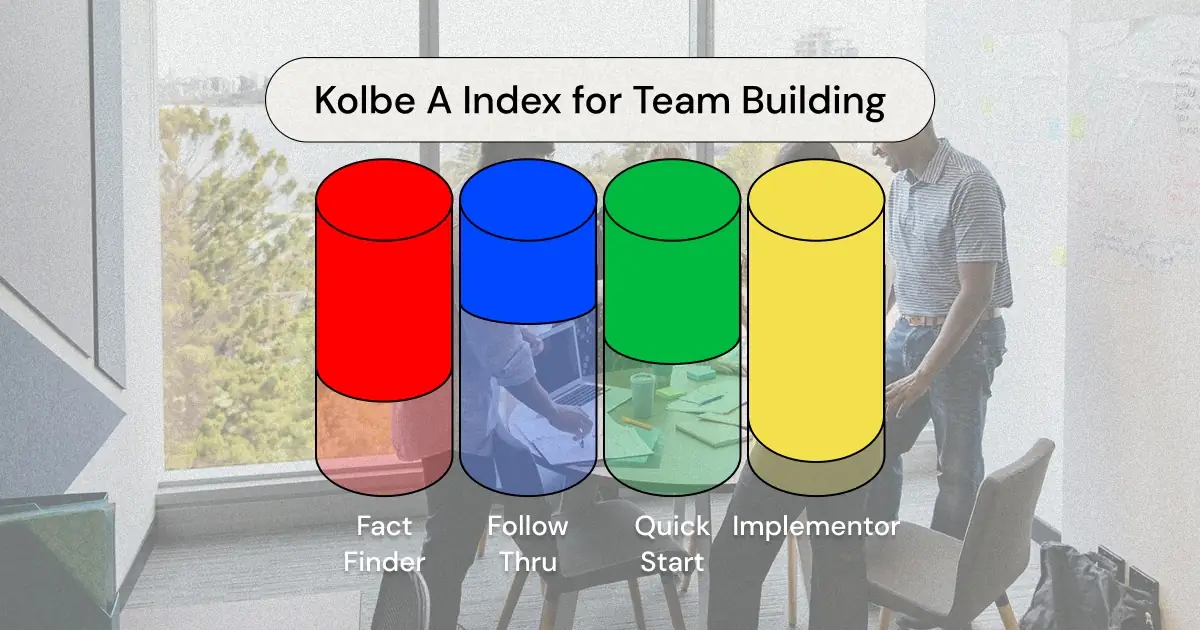
The four Action Modes
- Fact Finder: how you gather and share information.
- Follow Thru: how you organize and design.
- Quick Start: how you deal with risk and uncertainty.
- Implementor: how you handle space and tangibles.
Each mode describes a range of approaches. A higher score is not universally better. For example, detailed investigation and starting with an overview can both contribute, depending on the task.
The Role of the Kolbe A Index in Team Building
Kolbe offers team applications. Individual results can help colleagues explain differences in how they approach a task and discuss where support or a different process would help. Ask people how a result relates to their actual experience instead of assigning a role from a score.
Applying different approaches to one project
For a product launch, ask how much information people need before starting, how they want to organize handoffs, how they respond to uncertainty, and whether a tangible prototype would help. Agree what the project needs and how different approaches will contribute. This is an example of a discussion, not a documented customer outcome.
How to Implement the Kolbe A Index in Your Team
Step-by-Step Guide to Conducting the Test
- Choose an outcome. Identify a problem such as delayed handoffs or repeated changes to a plan. Explain why the team is using the assessment.
- Arrange the official assessment. Check current administration guidance, accessibility needs, included reports, and facilitator support. Give participants time to complete it.
- Discuss the results. Invite each participant to explain examples they are comfortable sharing. Consult the report guidance or a qualified facilitator if interpretations are unclear.
- Apply one agreement. Decide what information, structure, experiments, or tangible work the project needs. Assign responsibilities using skills, interests, experience, and capacity alongside the discussion.
- Review the change. Set a date to ask whether the agreement helped. Revisit the work process as the project or team changes.
Interpreting the Results
Keep all four modes in view. Avoid interpreting Quick Start as a creativity score or Implementor as a general measure of execution skill. Ask what a person needs to contribute, and let them explain where the result fits or needs context.
Continuous Development Using Kolbe
A result can remain a reference for discussion while the team’s circumstances change. Review working agreements, workload, and support needs rather than assuming every new problem calls for reassignment or another assessment.
Your rapid TeamDynamics · two minutes
What makes your team tick?
Start with how your meetings work. Answer 12 quick questions for a first look at how your team communicates, makes decisions, and gets things done.
When we have team meetings…
Question 1 of 12 · Choose an answer to startCost Analysis of the Kolbe A Index Test
Breaking Down the Pricing
As checked on October 7, 2026, Kolbe’s official page lists the Kolbe A Index at $63. Budget for each participant and check whether team reports, coaching, or facilitation are included in your purchase. Verify the current offer before buying.
TeamDynamics Pro costs $39 per participant as a one-time payment. Pro includes a Team Profile, individual CoDynamics, a Manager Report, and a Team Discussion Guide. Solo costs $29 once for one person’s view of the team, with Estimated TeamDynamics and Your CoDynamics. Compare the included reports, participant count, and any facilitation costs before purchase.
Calculating the ROI
Define the problem and how you will review progress before estimating a return. For a handoff problem, track missed handoffs or the time spent clarifying ownership. Assessment results alone do not establish productivity gains or financial savings.
Is the Kolbe A Index Test Worth It? Pros and Cons of the Kolbe Test for Team Building
Advantages of Using the Kolbe A Index for Team Building
- A shared vocabulary for discussing instinctive approaches to action.
- A structured prompt for colleagues to explain different needs when tackling the same task.
- Team applications and facilitator support to consider when choosing a package.
Disadvantages and Limitations
- Assessment and facilitation costs require a clear development goal.
- Conative results do not cover every skill, interest, relationship, or working condition.
- Assigning fixed roles from scores can narrow people’s opportunities.
- A workshop needs follow-up; a report alone does not change a work process.
So, Worth It or Not?
Consider Kolbe when instinctive approaches to action are central to the discussion you want to have. Check the report and support you need, then plan how to apply the learning to a real project.
Comparing Kolbe with shared team behaviors
TeamDynamics measures the shared behaviors of a specific team across Communicating, Processing, Deciding, and Executing. In Pro, participants describe how the team works, and their completed responses contribute to a shared team profile.
Personal preferences separately inform CoDynamics, which helps each participant understand natural fit and potential tension with the team. They do not determine the team’s shared result.
Kolbe starts with individual conative approaches and offers ways to apply them with teams. TeamDynamics asks participants to describe shared team behaviors. Use the latter when your immediate question is how updates, information, decisions, and plans work in this particular group.
Turn different ways of working into a shared plan
Kolbe A explores instinctive approaches to action. TeamDynamics asks participants how their team works together. Explore the team profile, then discuss how updates, decisions, and plans will work on your next project.
Conclusion
Start with a concrete collaboration problem and choose an assessment that supports the conversation. Invite colleagues to interpret their own results, agree one change, and review its effects. Keep skills, experience, interests, and workload in the decision about who does what.