In today's hyper-competitive workplace, understanding yourself and your team members is more important than ever. That's where personality tests come in, promising insights into our strengths, weaknesses, and everything in between. The two heavyweights of the personality test world are DISC and StrengthsFinder, but which one reigns supreme?
Looking for a holistic round-up of alternatives? Check out the best alternatives to DiSC and the top 5 alternatives to StrengthsFinder.
It's time for a hot take on these popular tools and a no-holds-barred comparison to help you decide which test deserves your time and energy.
Round 1: The Basics
Before we dive into the fray, let's take a moment to understand the contenders. The DISC assessment, based on a theory developed by psychologist William Marston, categorizes individuals into four primary personality types: Dominance (D), Influence (I), Steadiness (S), and Conscientiousness (C). By measuring an individual's tendencies and preferences, the DISC test aims to enhance self-awareness, improve communication, and promote more effective teamwork.
On the other hand, the StrengthsFinder assessment, developed by Gallup and based on the research of Donald Clifton, focuses on identifying an individual's top strengths from a list of 34 talent themes. The idea is to help people understand and leverage their innate strengths to achieve personal and professional success.
Round 2: Methodology and Approach
Let's get down to the details. The DISC assessment is a relatively quick and easy test, often taking less than 20 minutes to complete. By exploring how an individual interacts with their environment, DISC can provide valuable insights into communication styles, decision-making processes, and conflict resolution strategies. It's particularly useful for teams experiencing communication breakdowns or misunderstandings, as it promotes empathy and understanding among team members with different personality styles.
Wondering what your DiSC communication style is? Want to help your team learn about communicating with different DiSC styles? Check out our FREE downloadable DiSC resources!
StrengthsFinder, on the other hand, is a more in-depth assessment that can take up to 45 minutes to complete. Its focus on strengths rather than weaknesses fosters a positive and empowering environment for personal and professional growth. By identifying and leveraging their strengths, individuals can maximize their potential and better understand how to collaborate with others. However, StrengthsFinder's emphasis on individual strengths may inadvertently gloss over potential areas of improvement or interpersonal challenges.
Round 3: Practical Applications
When it comes to practical applications in the workplace, DISC and StrengthsFinder both have their merits.
DISC shines when it comes to understanding team dynamics and improving communication. By identifying the different behavioral styles within a team, DISC can help you pinpoint potential conflicts and develop strategies to address them. It's also great for improving communication, as you learn how to adapt your style to better suit the needs of others.
StrengthsFinder, on the other hand, excels in personal and professional development. By identifying your unique talents and strengths, StrengthsFinder helps you build on what you're naturally good at, rather than focusing on your weaknesses.
Want to hold a team building workshop using CliftonStrengths? Check out our free downloadable StrengthsFinder team building resources!
This can lead to increased engagement, motivation, and productivity in the workplace.
Round 4: Limitations and Criticisms
No personality test is perfect, and both DISC and StrengthsFinder have their fair share of criticisms.
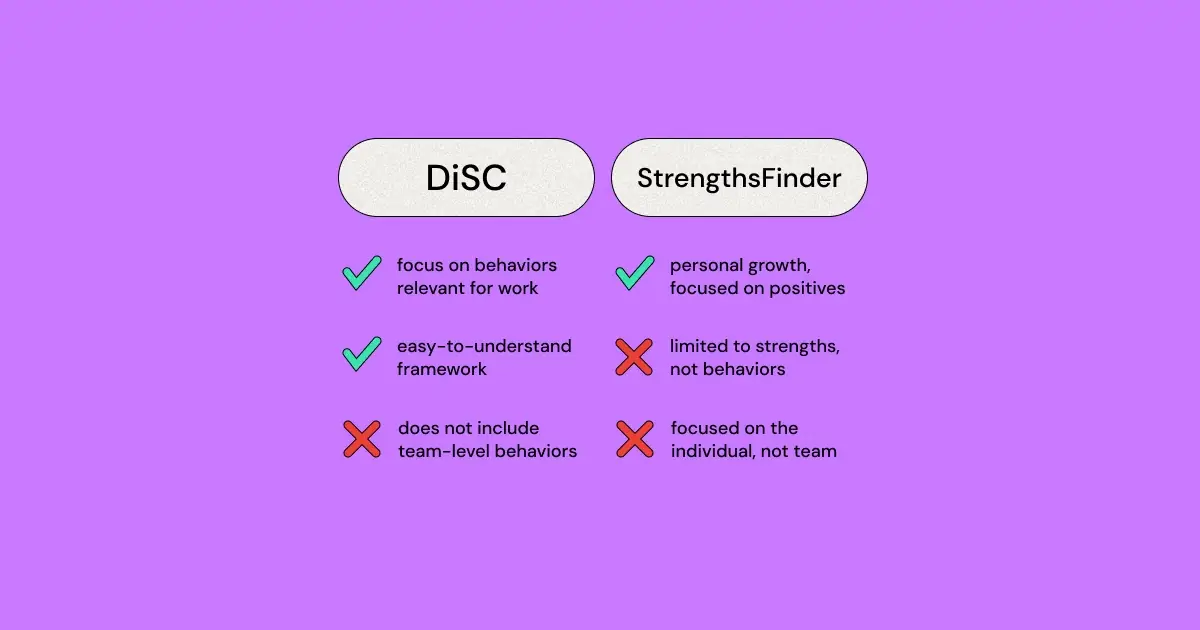
One limitation of DISC is that it focuses primarily on behavior, rather than exploring the underlying motivations and emotions behind those actions. As a result, some people argue that DISC is too simplistic and lacks the depth needed for true personal and professional growth.
Looking for the best alternatives to DiSC? Check out the top 5 alternatives to DiSC.
StrengthsFinder, on the other hand, has been criticized for its focus on individual strengths at the expense of addressing weaknesses. Some argue that, by only concentrating on what we're good at, we're neglecting areas where we need improvement. Additionally, the sheer number of strengths (34 in total) can be overwhelming for some people, making it difficult to prioritize and develop their talents effectively.
Round 5: Team Dynamics
In the arena of team dynamics, neither emerge as the clear winner.
DISC lends itself well to understanding and improving the 1-to-1 interactions and relationships within a team. For example, by recognizing the unique traits and preferences of each team member, leaders can allocate tasks, set goals, and foster a collaborative environment more effectively.
StrengthsFinder, while offering valuable insights into individual strengths, does not directly address team dynamics. Its emphasis on personal talents makes it better suited for individual development rather than team cohesion.
However, despite how frequently both tests are administered in the workplace, neither of them is well-suited for understanding the nuances of group dynamics that sit at the heart of most modern, team-based work.
That’s why we built TeamDynamics. TeamDynamics helps you objectively assess, describe, and act on the unique ways in which your team interacts to accomplish its shared work. Put differently, TeamDynamics describes your team chemistry.
Equipped with your TeamDynamics, you can take action to improve your group dynamics and performance:
- Build your team by defining team culture and values, setting actionable team norms, and conducting high-impact team offsites;
- Manage your team better by coaching team members, turbocharging cross-team collaboration, and resolving team conflicts;
- Recruit and hire more effectively by honing your recruiting pitch, refining your interview process, and accelerating new hire onboarding;
And much more!
Round 6: Popularity and Accessibility
Both DISC and StrengthsFinder have achieved widespread popularity, with millions of people worldwide using them for self-improvement and team development. DISC has the advantage of being more accessible, with many free or low-cost versions available online. In contrast, the StrengthsFinder test requires purchasing a book or access code, which can be a barrier for those on a tight budget.
Conclusion
Both DISC and StrengthsFinder are useful personality tests. However, the key to getting the most out of these personality tests is knowing when to use them, and when not to.
The DISC test's primary strength is its simplicity and ease of understanding. The four distinct personality types make it easy for individuals and teams to quickly grasp the core concepts, allowing for rapid implementation in the workplace. Additionally, the emphasis on communication styles helps teams identify potential pitfalls in interpersonal relationships and adapt their communication to work more effectively with diverse personality types.
However, The simplicity of the DISC test can also be its Achilles heel. The four basic personality types may not provide the granularity and depth needed to explore more complex aspects of an individual's personality. Moreover, the DISC assessment tends to focus on behavior rather than strengths, which may limit its usefulness in identifying areas where employees can excel and contribute to the organization's success.
In contrast, the key strength of the StrengthsFinder test lies in its focus on an individual's unique strengths and talents. By identifying and leveraging these strengths, employees can increase their productivity, job satisfaction, and engagement. The assessment also provides a more nuanced understanding of an individual's abilities, as it uncovers a broader range of strengths across the four domains.
But one potential downside to the StrengthsFinder assessment is its complexity. With 34 unique strengths to consider, it can be challenging for individuals and teams to absorb and implement the results. Additionally, the test's emphasis on strengths may leave blind spots in identifying potential areas for improvement or growth.
And neither StrengthsFinder nor DISC is designed to understand group personality or team chemistry. When you're looking to improve the performance of your team, help your teammates work with other groups, or hire people who will fit in with your team, you should look for another behavioral assessment. Consider TeamDynamics, which is the only personality test built specifically for modern teams.