
How to run a project kickoff meeting
To run a project kickoff meeting, confirm the outcome and scope, clarify owners and dependencies, and agree how information, decisions, and changes will be handled. Walk through the first deliverable before closing. Record the next actions with owners and dates, then review the agreement after the first delivery.

- Use this when
- People agree on the project goal but have different assumptions about how they will deliver it together
- Built for
- Project leads and temporary or cross-functional teams starting a new piece of work
- The outcome
- A short project working agreement that makes the first deliverable and next steps clear.
MAKE THE PATTERN DISCUSSABLE
Agree how the project will work before work accelerates.
A project brief describes the work; a kickoff must also establish how the people doing it will coordinate. Different communication, evidence, and planning habits can stay hidden until the first missed dependency. Use the framework to ask about those assumptions before the project relies on them.
THE PLAYBOOK
A 60-minute project kickoff agenda
This kickoff turns the project brief into shared expectations about delivery. Keep the agreement short enough to use during the next handoff or decision.
Prepare for the conversation
Circulate a short brief covering the outcome, scope, constraints, known dependencies, and first deliverable. Invite the people who own or receive the work and someone able to confirm project authority. Ask participants to bring one coordination risk. TeamDynamics results can inform questions about working habits; the project does not need a new assessment merely to use the kickoff agenda.
- 01
First 15 minutes: align on the outcome and boundaries
Confirm the problem, the intended outcome, the first deliverable, and the main constraint. Ask people to describe what is in and out of scope in their own words. Identify assumptions still needing evidence, and separate committed dates from estimates.
- 02
Next 25 minutes: agree ownership and ways of working
Name the owner for each immediate outcome, the decision owner, and the key dependencies. Agree where the current project record lives, how contributors give input, and what a ready handoff contains. If people bring results from different teams, compare those contexts rather than inventing a combined project type.
- 03
Final 20 minutes: walk through the first delivery
Trace the first deliverable from its starting task to acceptance. Confirm owners, dates, evidence needed, and who receives the work. Decide how a change to scope or timing will be raised and approved. Publish the short agreement and schedule a checkpoint after the first delivery.
A WORKED EXAMPLE · ILLUSTRATIVE
Make the first project handoff explicit
Design expects to share a direction for discussion, while engineering expects a ready-to-build specification. Both teams have marked the same date as the handoff.
The working agreement
The first handoff is a discussion draft. Design includes the open questions and the decision needed; engineering gives feasibility input by the agreed review date. The project lead records the chosen direction before implementation planning begins.
- Who owns it
- Design owns the discussion draft, engineering owns feasibility input, and the project lead owns the recorded direction.
- When to review
- Review immediately after the first handoff.
- A sign of progress
- Both groups can state what the deliverable is ready for and which decision must happen before implementation.
THE RELEVANT DIMENSIONS
Put precise language around the work.
TeamDynamics describes four parts of team behavior. For this moment, these are especially useful places to begin.
How information moves
How a course of action is chosen
How the team works toward its goals
START THE CONVERSATION
Discussion prompts: Project kickoffs
- 01
What would success look like for the first deliverable?
- 02
Which assumption about how we work together needs to be explicit?
- 03
Who needs to know when scope, timing, or a dependency changes?
PUT IT INTO PRACTICE
Review what changed in the work.
Publish the working agreement with the project brief, along with the immediate actions and unanswered questions. At the first checkpoint, compare the agreed handoff with what actually happened. Update any assumption that proved wrong and make changes visible to the people affected. Use the cross-team collaboration playbook for a deeper recurring dependency, and use a retrospective after a meaningful delivery to decide what to carry forward.
Common questions: Project kickoffs
Who should attend a project kickoff?
Include the people accountable for the first outcomes, key contributors, and those who receive important handoffs. Bring a sponsor or decision owner when their authority is needed to resolve scope and constraints. Share the record with people who need awareness but do not need to attend.
How is a kickoff different from a planning meeting?
A kickoff establishes shared purpose, boundaries, ownership, and working expectations. Detailed planning develops the tasks and estimates needed to deliver. The kickoff should identify the first deliverable and planning owners without trying to solve every implementation detail in one session.
KEEP EXPLORING
One framework, more team moments.
 Storming
Cross-team collaboration
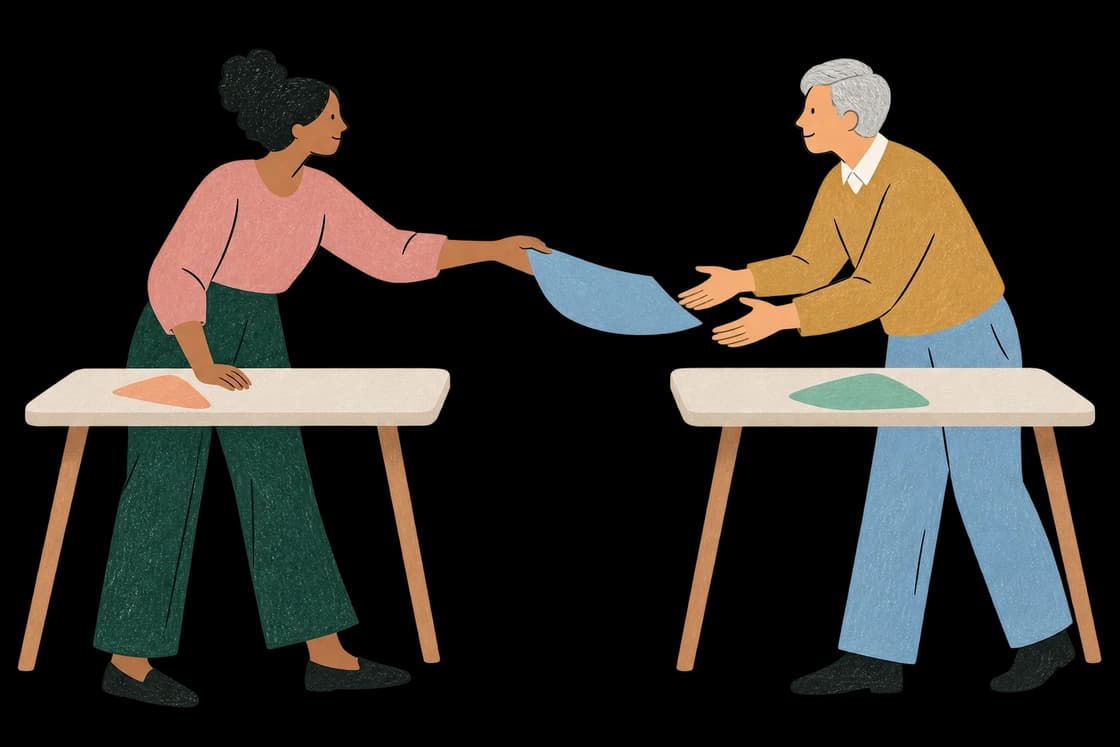
Find differences in working style before they slow the project.
 Norming
Roles and responsibilities
A usable ownership map with explicit handoffs, delegated authority, and escalation rules.
 Norming
Team retrospectives
One practical improvement with an owner, a test in real work, and a review date.
YOUR TEAM, MADE VISIBLE
Give this conversation a shared starting point.
Add the complete roster once. Everyone contributes to the team result and receives guidance they can use.