
How to run effective team meetings
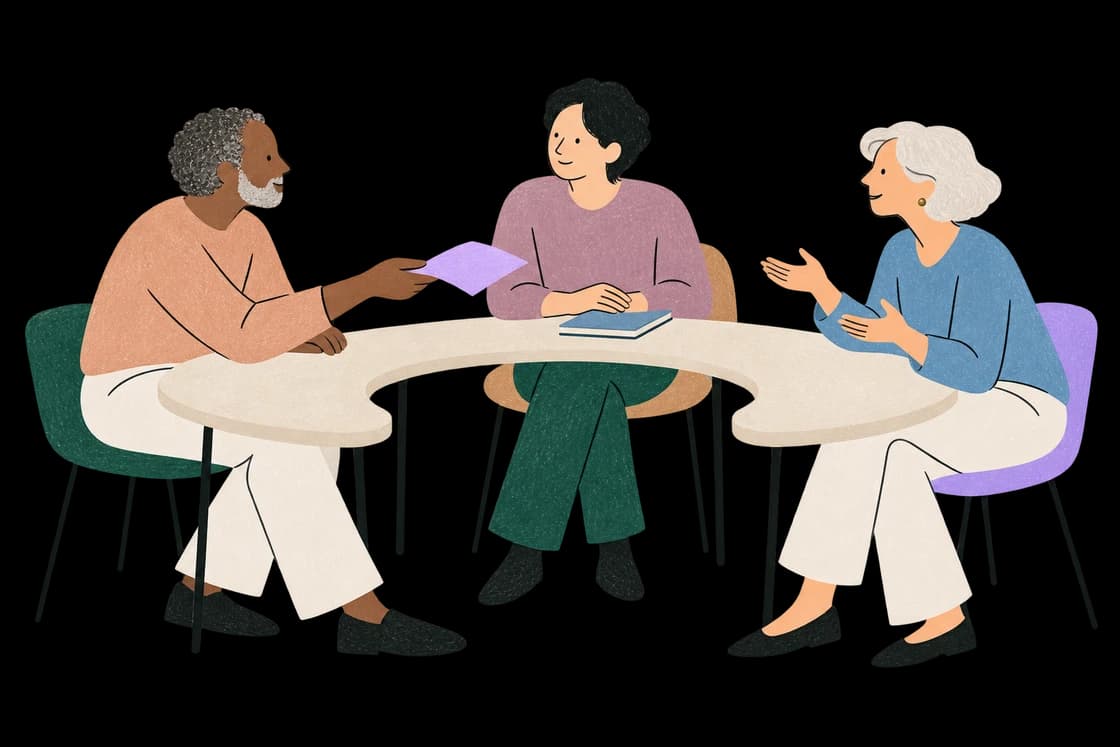
To run an effective team meeting, give it one clear purpose, share the essential context in advance, make room for different ways of contributing, and close with recorded actions and owners. Redesign one recurring meeting, test the format twice, and review whether it helped the work move forward.
- Use this when
- The same meeting takes time but leaves people unclear about what changed or what happens next
- Built for
- Team leaders and facilitators improving a recurring meeting
- The outcome
- A redesigned meeting with a clear purpose, useful participation, and a reliable close.
MAKE THE PATTERN DISCUSSABLE
Make time together earn its place.
A meeting can be lively without moving the work forward. The team’s Communicating and Processing patterns can help explain who arrives ready to speak, who needs time with the evidence, and whose contribution the current format misses. Use those patterns to redesign one real meeting.
THE PLAYBOOK
A 40-minute reset for one recurring meeting
This is a workshop to improve a recurring meeting, rather than another standing meeting to maintain. Bring its current agenda and leave with a replacement you can test.
Prepare for the conversation
Choose a meeting that everyone recognizes and collect its last two agendas or notes. Ask participants what they need from it and where it currently wastes effort. Bring the team result and Team Discussion Guide if available. Write a one-sentence purpose and invite colleagues who are usually quiet or absent to contribute before the workshop.
- 01
First 10 minutes: name the job of the meeting
Choose one recurring meeting and its next occurrence. Decide whether its main purpose is to share information, explore a problem, make a decision, or coordinate delivery. Move routine updates into an accessible record when discussion is unnecessary. State what people should leave knowing or owning.
- 02
Next 15 minutes: design preparation and participation
Review the team’s Communicating and Processing patterns alongside examples from recent meetings. Send a short question and the essential evidence in advance. Allow quiet thinking before discussion, invite contributions beyond the fastest speakers, and give absent teammates a route to add input.
- 03
Final 15 minutes: define the close and test it
Name a facilitator and protect the final five minutes. Record the choice or learning, the next action, its owner, and its date. Try the redesigned format twice, then check whether people can find and describe the same outcome without another meeting.
A WORKED EXAMPLE · ILLUSTRATIVE
Make a weekly review useful to quieter contributors
A weekly review starts with spoken updates. By the time the lead asks for risks, the meeting is nearly over and colleagues who need to consider the evidence have had little chance to contribute.
The working agreement
Post the short status record the day before. Open with two minutes to read and add questions, discuss the two issues needing joint attention, and finish by recording each next action with an owner and date.
- Who owns it
- The facilitator shares the prompt and protects the close; action owners update the record.
- When to review
- Review the next two weekly meetings.
- A sign of progress
- Participants can name the meeting’s outcome and find their next action without asking for a recap.
THE RELEVANT DIMENSIONS
Put precise language around the work.
TeamDynamics describes four parts of team behavior. For this moment, these are especially useful places to begin.
How information moves
How information becomes insight
How a course of action is chosen
START THE CONVERSATION
Discussion prompts: Team meetings
- 01
What work genuinely needs everyone together?
- 02
Whose contribution does our current format make easy to miss?
- 03
What should be clear in the final five minutes?
PUT IT INTO PRACTICE
Review what changed in the work.
Keep the revised agenda beside the meeting invitation. After two trials, compare the purpose with the actual notes: did the group do the work it met to do? Ask whether people had enough context and a fair route to contribute. Keep, adjust, shorten, or cancel the meeting based on those examples. Use Put it to work to shape the experiment, then keep the working record in the tools your team already uses.
Common questions: Team meetings
How long should a team meeting be?
Give the meeting the shortest time that allows its purpose to be met. A status update may need a shared record rather than a meeting; a complex discussion may need preparation and more time. Start with the work, reserve time to close, and review the length after two trials.
How do you get quieter teammates to participate?
Share the question and evidence beforehand, allow a short period of individual thinking, and invite written as well as spoken input. Ask what would make contributing easier rather than treating quietness as a lack of interest. Capture contributions before the group commits to a direction.
KEEP EXPLORING
One framework, more team moments.
YOUR TEAM, MADE VISIBLE
Give this conversation a shared starting point.
Add the complete roster once. Everyone contributes to the team result and receives guidance they can use.