
02 · Private to each participant · 9 completed responses
Your CoDynamics
Amazone Exec Team
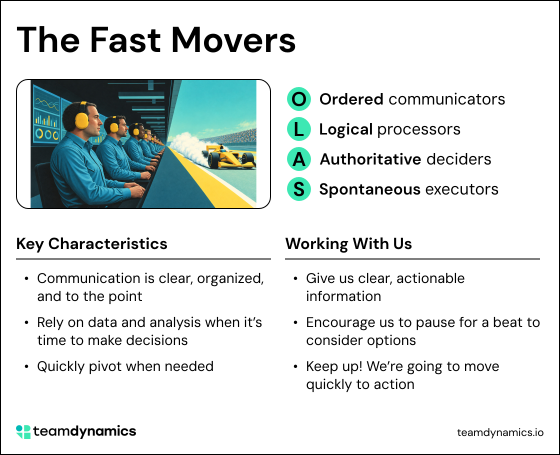
The Fast Movers
February 9, 2024 · Saved result
OLAS quick reference
Keep this overview handy for conversations about how your team works. It describes the team type, not anyone's personal results.
OLAS
The Fast Movers
- O
- Ordered communicators
- L
- Logical processors
- A
- Authoritative deciders
- S
- Spontaneous executors

Key characteristics
- Communication is clear, organized, and to the point
- Rely on data and analysis when it's time to make decisions
- Quickly pivot when needed
Working with us
- Give us clear, actionable information
- Encourage us to pause for a beat to consider options
- Keep up! We're going to move quickly to action

YOUR READING PATH
How do my preferences fit this team?
- Who it is for
- Private to each participant
- What it gives you
- See where working with this team may feel natural and where you may need to flex or ask for support.
- How to use it
- Reflect privately first. Share only the observations that will help you collaborate.
READ THIS FIRST
Start with the team around you
Begin with the team's shared behavior, then compare it with your own working preferences.
 Natural fit
3 of 4 dimensions
Your stated preferences point in the same direction as the team's captured behavior.
 Potential tension
1 of 4 dimensions
Where your working preferences differ from the team’s habits.
Comparison basis
OLAS
This report compares your preferences with the team's saved OLAS result (The Fast Movers).
Understanding natural fit and potential tension
Your CoDynamics compare your own working preferences with your team's habits.
Natural fit
Natural fit means your preferences align with the team's approach. These situations may feel more comfortable.
Potential tension
Potential tension means you prefer a different approach. Recognizing these situations helps you prepare and ask for support.
Make it useful
Think of a recent situation: what felt comfortable or difficult, and what would help next time?
Use your CoDynamics to decide which working differences you want to discuss with your manager or teammates.
About this report
Based on 9 completed assessments included in this saved result. TeamDynamics describes how your team works together; your private CoDynamics explores how your preferences fit.
How your results are calculated
Participants answer the same questions about how the team communicates, processes information, makes decisions, and gets work done. Completed assessments are combined into four scales, showing the direction and strength of the team’s working patterns.
Personal preferences inform private CoDynamics guidance. They do not change the team's shared result.
This report reflects the assessments included when this result was saved. Your team may have changed since then.
THE FOUR DIMENSIONS
How this team tends to work
A marker near the center is moderate. “Very strongly” appears only in the outermost zones of the scale.
communicating
Strongly Ordered
About communicating
How does your team share information?
Ordered and Informal describe the two approaches in this dimension. Your team may use both; its preference is the one it relies on more naturally.
- Ordered
- Information is shared through defined processes and forums.
- Informal
- Information is shared organically among team members.
processing
Very strongly Logical
About processing
How does your team interpret shared information?
Relational and Logical describe the two approaches in this dimension. Your team may use both; its preference is the one it relies on more naturally.
- Relational
- The source of information matters when evaluating it.
- Logical
- Information is evaluated on its own merits, regardless of source.
deciding
Strongly Authoritative
About deciding
How does your team arrive at a course of action?
Concordant and Authoritative describe the two approaches in this dimension. Your team may use both; its preference is the one it relies on more naturally.
- Concordant
- Decisions are driven by consensus among team members.
- Authoritative
- Decisions are driven by direction from team leadership.
executing
Moderately Spontaneous
About executing
How does your team work toward its objectives?
Deliberate and Spontaneous describe the two approaches in this dimension. Your team may use both; its preference is the one it relies on more naturally.
- Deliberate
- Plans are thorough, closely followed, and regularly updated.
- Spontaneous
- Lightweight plans favor agility and adaptability.
Your CoDynamics · Jeff B.
Generating insights
Potential tensionCommunicating
Your natural preferences tend towards more organic and flexible means of gathering and sharing information than how the team typically behaves
What you can try
- Ask the team to make it easier for you to engage with the rest of the group by clarifying expectations around structured communications (”What information do we share, when, and how do we do so?”) and by developing guidelines and templates for the team’s most common mechanisms for sharing information
- Look out for situations in which your team is tasked with solving creative problems that require new models, frameworks or concepts; in these moments, your natural tendency towards a more free-flowing, organic approach to information exchange will help you adapt more quickly to the situation at hand
Natural fitProcessing
You instinctively rely on rigorous reasoning in advancing your perspectives in a way that is natural to your team
What you can try
- Help clarify the team’s expectations and norms around analysis with the more relationship-driven individuals on the team by sharing with them a variety of past examples of the team’s approach to interpreting information
- If there are specific experts on the team who have context, knowledge or abilities that uniquely fit the information at hand, it may be both faster and more effective to rely on their judgment, rather than applying the team’s typical approach of building a broadly understood analytical framework to guide the interpretation
Translating insights into action
Natural fitDeciding
You are typically decisive in decision-making and feel comfortable with clear direction on a course of action, in line with your team's approach to decision-making
What you can try
- If a naturally consensus-driven team member is asked to lead a decision, help them weigh the relative importance of the input they are soliciting and help them calibrate to the team’s expectations around when sufficient input has been gathered and incorporated
- When confronted with a decision that will lead to a particularly difficult, time-consuming, or counter-intuitive course of action, encourage the team’s leadership to invest more time in socializing and debating the decision to create more buy-in and broader commitment to the path ahead
Natural fitExecuting
Your plans are lightweight and reactive to new information throughout project implementation, which is similar to how your team implements projects
What you can try
- Help the more deliberate members of the team identify and prioritize the areas where they most need clarity from a planning and ongoing execution perspective, and work with the rest of the team to provide that clarity
- When tackling an effort where the consequences of an unexpected outcome (or delay) would be significant, push your team (and yourself) to set aside the natural instinct for lightweight, reactive plans in favor of a more detailed blueprint for execution
TURN INSIGHT INTO ACTION
Prepare for your next team conversation
These suggestions come from your CoDynamics guidance. Select the ones that would make collaboration easier now.
MAKE IT STICK
Turn insight into a 30-day experiment
Name who will keep the commitment moving, when you will revisit it, and the observable signal that would show progress.
This working draft stays in this tab. It is not saved to your result and contains no assessment answers.
Choose the ideas you want to discuss, then copy a clean working agreement into the place your team already plans its work.