
03 · For managers and authorized administrators · 9 completed responses
Manager Report
Amazone Exec Team
The Fast Movers
February 9, 2024 · Saved result
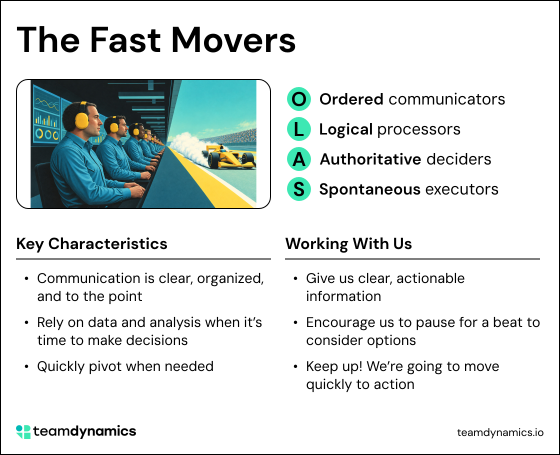
OLAS quick reference
Keep this overview handy for conversations about how your team works. It describes the team type, not anyone's personal results.
OLAS
The Fast Movers
- O
- Ordered communicators
- L
- Logical processors
- A
- Authoritative deciders
- S
- Spontaneous executors

Key characteristics
- Communication is clear, organized, and to the point
- Rely on data and analysis when it's time to make decisions
- Quickly pivot when needed
Working with us
- Give us clear, actionable information
- Encourage us to pause for a beat to consider options
- Keep up! We're going to move quickly to action

YOUR READING PATH
How can I help this team do its best work?
- Who it is for
- For managers and authorized administrators
- What it gives you
- Understand each team member's natural fit and potential tension to make concrete leadership choices. Individual coaching guidance remains private.
- How to use it
- Use fit and tension to guide supportive conversations and adjust team practices.
READ THIS FIRST
Start with the leadership picture
Begin with the team's shared behavior, then explore team members' natural fit and potential tension to decide where your leadership can help.
Where preferences align
27 across the team
The combined preferences that point in the same direction as the team's behavior.
Where preferences differ
9 across the team
Differences where a manager may need to make room for another way of working.
People behind the pattern
9 team members
See who experiences natural fit or potential tension in each dimension. Personal coaching guidance and raw answers are not shown.
Supporting your team
Use these patterns to ask what support helps each person do their best work. Discuss specific situations and agree on practical adjustments, rather than assigning people a label.
Invite people to discuss only the parts of their CoDynamics they feel comfortable exploring together.
Understanding your resultsAbout this report
Based on 9 completed assessments included in this saved result. TeamDynamics describes how your team works together; CoDynamics explores how individual preferences fit.
How your results are calculated
Participants answer the same questions about how the team communicates, processes information, makes decisions, and gets work done. Completed assessments are combined into four scales, showing the direction and strength of the team’s working patterns.
Personal preferences inform the fit-and-tension view. They do not change the team's shared result. Individual coaching guidance, preference scores, and raw answers remain private.
This report reflects the assessments included when this result was saved. Your team may have changed since then.
THE FOUR DIMENSIONS
How this team tends to work
A marker near the center is moderate. “Very strongly” appears only in the outermost zones of the scale.
communicating
Strongly Ordered
About communicating
How does your team share information?
Ordered and Informal describe the two approaches in this dimension. Your team may use both; its preference is the one it relies on more naturally.
- Ordered
- Information is shared through defined processes and forums.
- Informal
- Information is shared organically among team members.
processing
Very strongly Logical
About processing
How does your team interpret shared information?
Relational and Logical describe the two approaches in this dimension. Your team may use both; its preference is the one it relies on more naturally.
- Relational
- The source of information matters when evaluating it.
- Logical
- Information is evaluated on its own merits, regardless of source.
deciding
Strongly Authoritative
About deciding
How does your team arrive at a course of action?
Concordant and Authoritative describe the two approaches in this dimension. Your team may use both; its preference is the one it relies on more naturally.
- Concordant
- Decisions are driven by consensus among team members.
- Authoritative
- Decisions are driven by direction from team leadership.
executing
Moderately Spontaneous
About executing
How does your team work toward its objectives?
Deliberate and Spontaneous describe the two approaches in this dimension. Your team may use both; its preference is the one it relies on more naturally.
- Deliberate
- Plans are thorough, closely followed, and regularly updated.
- Spontaneous
- Lightweight plans favor agility and adaptability.
Start with one conversation
Leading with your TeamDynamics
This report compares team members' working preferences with the team's shared behavior. Individual coaching guidance, preference scores, and raw assessment answers remain private.
See your team’s fit and tension Continue toHelp your team make the most of its TeamDynamicsHelp your team make the most of its TeamDynamics
Choose one practice to improve
Start with a small change to how your team works together.
Why this helps
As a manager, the greatest leverage comes from improving the effectiveness of your team. Putting your TeamDynamics into practice will help you do just that.
Talk about your team’s pattern
Discuss the shared profile together, then follow up in team meetings and 1:1s.
Why this helps
Make sure everybody on your team knows both their TeamDynamics and which behaviors are more or less natural for them as individuals. Discuss your TeamDynamics as a group and follow up in subsequent team meetings and 1:1s.
Make time to revisit
Start with a six-month check-in, or revisit sooner when your team or its work changes.
Why this helps
Revisit your TeamDynamics on a regular cadence as things change, like team composition (people joining or departing), team structure (changes in roles and responsibilities) or the organizational context (rapid growth, new company objectives, etc). Reevaluating your TeamDynamics every 6 months is a good starting point, though quarterly and annually also work for some teams.
Lead the charge where you’re uniquely positioned to do so
Make your working style visible
Bring your TeamDynamics into onboarding, project kickoffs, and conversations with collaborators.
Why this helps
Add your TeamDynamics to new hire onboarding documentation/user guides, cross-team project kickoffs, and internal profiles/directories. Communicate your TeamDynamics to external collaborators too, so they know what to expect from your team.
Turn insight into a team habit
Use your team’s ideas to adjust meetings, planning, or professional development.
Why this helps
Your team will have great ideas about how to work together better based on your TeamDynamics. Incorporate these insights into your existing norms and processes — like weekly meetings, planning cycles, professional development, and so on — to put your results into practice.
Know when to flex
Spot situations that need a different approach. Explain why, and agree on what should change.
Why this helps
Help your team identify when it’s time to deviate from your team’s natural preferences. Acknowledge the change, explain the circumstances, and set clear expectations.
Help teams work across differences
Discuss how other teams work and where you may need to adapt together.
Why this helps
Your team likely works with many others; you probably have a decent hypothesis about these other groups’ TeamDynamics (or you can encourage them to take the assessment). Coach your team on what you have observed about how their TeamDynamics likely interact with yours.
Working with individuals’ CoDynamics
Read the pattern, then ask
Ask team members how they experience fit and tension in their daily work.
Why this helps
Each dimension shows natural fit and potential tension for each named team member. Use these patterns to guide conversations and adjust team practices. Individual coaching guidance, preference scores, and raw assessment answers remain private.
Invite a personal conversation
Give people space to share their own coaching guidance. Let them choose what to discuss.
Why this helps
The fit-and-tension view helps you understand different ways of working. Invite people to discuss their individual coaching guidance in one-on-one or group conversations, without requiring them to share it.
Support both ways of working
People can succeed whether their preferences fit the team naturally or create potential tension.
Why this helps
Help all CoDynamics be successful. Just as there is no such thing as a better set of TeamDynamics, individuals can be successful regardless of how naturally their preferences align with their TeamDynamics. The key is knowing how to support them (you’ll find more detailed coaching recommendations tailored for your TeamDynamics in this Manager Report):
Natural fit: look for blind spots
Coach people to recognize when the team’s usual approach needs to change.
Why this helps
Where individuals are natural fits, coach them to look out for scenarios where the team’s natural TeamDynamics might not be most applicable and they should flex their behaviors.
Potential tension: create an opening
Find situations where a different preference is an advantage, and help that person contribute.
Why this helps
Where individuals are in tension, watch for and create opportunities where their natural preferences would make them uniquely suited to succeed. Encourage them to step up and shine.
Team pattern · Ordered
Communicating: suggested coaching points
Use these points in coaching conversations with the team members shown below.
 5 natural fit
- Alex R.
- Jordan M.
- Morgan L.
- Casey N.
- Avery P.
Help those on the team who are less naturally organized by clarifying expectations around structured communications and developing guidelines and templates for how we share information as a team.
Flex into a more organic, free-flowing communication style when we are working on gathering new information or coming up with new ideas. In these cases, starting with quick conversations can save us time and lead to better outcomes.
 4 potential tension
- Jeff B.
- Taylor S.
- Riley C.
- Sam K.
Make it easier for yourself to plug into the team’s practices by asking the team to clarify expectations and provide guidelines around structured communications. Ask teammates to share examples of past documents that have been well-received.
When we need to uncover new information or share new ideas across the team, your natural bias for free-flowing communication is the better approach. Help our team move faster by making sure we’re not spending time coming up with a model or framework when a quick conversation would suffice.
Team pattern · Logical
Processing: suggested coaching points
Use these points in coaching conversations with the team members shown below.
8 natural fit
- Jeff B.
- Alex R.
- Jordan M.
- Taylor S.
- Morgan L.
- Casey N.
- Sam K.
- Avery P.
Not everyone on the team may share your analysis-first approach to interpreting information. Help the more relationship-driven individuals on our team by sharing with them past examples of how we analyzed information as a team, so they can understand what works best in our context.
While it’s great to ground so much of our thinking in rigorous reasoning and analysis, sometimes the most consequential input comes from specific individuals who have unique expertise, context, and influence. Let’s remind ourselves to seek out and incorporate their perspectives when we’re gathering insights.
1 potential tension
- Riley C.
When you’re interpreting data and information, ask your teammates (or me) for past examples of how we did so as a team, so you can understand the types of analytical approaches that work best in our context.
Your natural tendency to look for and turn to individuals who have unique expertise or context can augment — though it won’t replace — our team’s naturally rigorous analytical approach. Help cover our team’s blind spots by reminding us which individuals have the most influence in each domain and make sure we’re weighing their input appropriately.
Team pattern · Authoritative
Deciding: suggested coaching points
Use these points in coaching conversations with the team members shown below.
7 natural fit
- Jeff B.
- Alex R.
- Jordan M.
- Taylor S.
- Riley C.
- Casey N.
- Sam K.
If a naturally consensus-driven teammate is leading a decision, help them avoid spinning their wheels by calibrating them to the team’s expectations around when a sufficient amount of input has been gathered and incorporated. It will likely be less than their natural instincts would suggest.
Certain decisions — especially those that will lead to a particularly difficult, time-consuming, or counter-intuitive course of action — benefit from more buy-in among the team. When the team is facing one of these, encourage leadership to spend more time socializing and debating the decision to create broader commitment to the path ahead.
2 potential tension
- Morgan L.
- Avery P.
If you are being asked to lead a decision, ask team leadership to help you weigh feedback and calibrate expectations around when sufficient input has been gathered and incorporated. Don’t be surprised if you find that the team expects you to get less input than you’d assume.
Your instinct to build consensus is especially helpful when the team is making decisions that will lead to particularly difficult, time- consuming, or counter-intuitive courses of action. In these situations, encourage team leadership to make more space for discussion to generate greater buy-in from the team for the path ahead.
Team pattern · Spontaneous
Executing: suggested coaching points
Use these points in coaching conversations with the team members shown below.
7 natural fit
- Jeff B.
- Alex R.
- Jordan M.
- Morgan L.
- Riley C.
- Sam K.
- Avery P.
Help the more deliberate members of the team identify and prioritize the areas where they most need clarity from a planning and ongoing execution perspective. Then help them work with the rest of the team to get that clarity.
When tackling an effort where the consequences of an unexpected outcome (or delay) would be significant, push your team (and yourself) to set aside the natural instinct for lightweight, reactive plans in favor of creating and maintaining a more detailed blueprint for execution.
2 potential tension
- Taylor S.
- Casey N.
Identify and prioritize the most important areas where you need clarity from a planning and ongoing execution perspective. Ask your team to provide that clarity in those places, but trust their more organic tendencies in other areas.
The team’s natural tendency for lightweight, reactive plans works less well when the consequences of an unexpected outcome (or delay) would be significant. In these moments, we can benefit from your ability to build and maintain detailed blueprints for execution.
TURN INSIGHT INTO ACTION
Choose a leadership adjustment
Use the combined pattern to change a team practice without singling out an individual participant.
MAKE IT STICK
Turn insight into a 30-day experiment
Name who will keep the commitment moving, when you will revisit it, and the observable signal that would show progress.
This working draft stays in this tab. It is not saved to your result and contains no assessment answers.
Choose the ideas you want to discuss, then copy a clean working agreement into the place your team already plans its work.