
01 · For everyone on the team · 9 completed responses
Team Profile
Amazone Exec Team
The Fast Movers
February 9, 2024 · Saved result
OLAS quick reference
Keep this overview handy for conversations about how your team works. It describes the team type, not anyone's personal results.
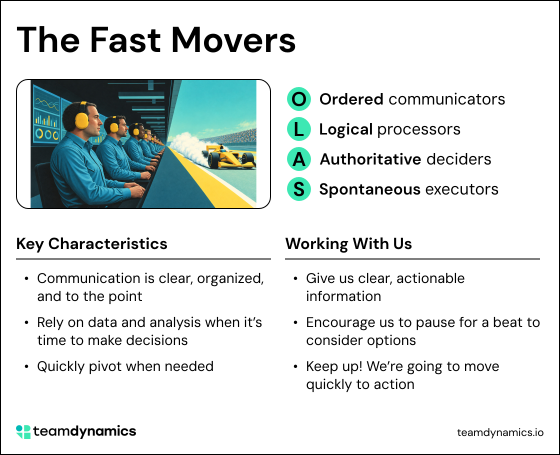
OLAS
The Fast Movers
- O
- Ordered communicators
- L
- Logical processors
- A
- Authoritative deciders
- S
- Spontaneous executors

Key characteristics
- Communication is clear, organized, and to the point
- Rely on data and analysis when it's time to make decisions
- Quickly pivot when needed
Working with us
- Give us clear, actionable information
- Encourage us to pause for a beat to consider options
- Keep up! We're going to move quickly to action

YOUR READING PATH
How does this team naturally work?
- Who it is for
- For everyone on the team
- What it gives you
- Build a shared understanding of the team's type, four dimensions, strengths, and blind spots.
- How to use it
- Read this first, then choose one working practice to discuss together.
READ THIS FIRST
Start with the shared pattern
Explore how your team communicates, processes information, makes decisions, and executes plans.
Most pronounced pattern
Very strongly Logical
Processing sits furthest from the midpoint in this result.
Least pronounced pattern
Moderately Spontaneous
Executing is nearest the midpoint relative to this team's other dimensions. Read the scale itself before assuming flexibility.
Responses included
9 completed responses
This result includes exactly the responses completed by February 9, 2024. It will not change as new responses arrive.
Using your Team Profile
No team type is better or worse. Your team can use both approaches in each dimension; the result shows which it tends to rely on more naturally.
- Use concrete examples to understand which team habits help and where you want to adapt.
- Make working expectations clear to new teammates and collaborators.
- Agree when to try a different approach and what that means in practice.
- Revisit your working norms as people, projects, or organizational needs change.
About this report
Based on 9 completed assessments included in this saved result. TeamDynamics describes how your team works together; your private CoDynamics explores how your preferences fit.
How your results are calculated
Participants answer the same questions about how the team communicates, processes information, makes decisions, and gets work done. Completed assessments are combined into four scales, showing the direction and strength of the team’s working patterns.
Personal preferences inform private CoDynamics guidance. They do not change the team's shared result.
This report reflects the assessments included when this result was saved. Your team may have changed since then.
THE FOUR DIMENSIONS
How this team tends to work
A marker near the center is moderate. “Very strongly” appears only in the outermost zones of the scale.
No team type is better or worse. Your team can use both approaches in each dimension; the result shows which it tends to rely on more naturally.
communicating
Strongly Ordered
About communicating
How does your team share information?
Ordered and Informal describe the two approaches in this dimension. Your team may use both; its preference is the one it relies on more naturally.
- Ordered
- Information is shared through defined processes and forums.
- Informal
- Information is shared organically among team members.
processing
Very strongly Logical
About processing
How does your team interpret shared information?
Relational and Logical describe the two approaches in this dimension. Your team may use both; its preference is the one it relies on more naturally.
- Relational
- The source of information matters when evaluating it.
- Logical
- Information is evaluated on its own merits, regardless of source.
deciding
Strongly Authoritative
About deciding
How does your team arrive at a course of action?
Concordant and Authoritative describe the two approaches in this dimension. Your team may use both; its preference is the one it relies on more naturally.
- Concordant
- Decisions are driven by consensus among team members.
- Authoritative
- Decisions are driven by direction from team leadership.
executing
Moderately Spontaneous
About executing
How does your team work toward its objectives?
Deliberate and Spontaneous describe the two approaches in this dimension. Your team may use both; its preference is the one it relies on more naturally.
- Deliberate
- Plans are thorough, closely followed, and regularly updated.
- Spontaneous
- Lightweight plans favor agility and adaptability.
Understanding your team
OLAS teams are defined by their structured communication, logical thinking, authoritative leadership, and ability to adapt plans quickly. They excel in fast-paced environments where they can quickly make sense of new information and act on it decisively. These teams are at their best in situations that require sharp, immediate responses.
However, OLAS teams can stumble when faced with projects that need a lot of new, creative thinking and detailed coordination over time. Their quick decision-making can lead to premature actions, especially in situations without strong data.
Continue toCharacteristicsCharacteristics
- Maintain a structured way of sharing information, ensuring that everyone understands their roles and responsibilities clearly, streamlining decision-making.
- Decision-making is top-down, with leaders quickly setting the direction and expectations, enabling fast responses to changing conditions.
- Despite their structured approach, OLAS teams are known for their flexibility in execution, ready to adjust plans spontaneously as new information becomes available.
Where your team excels
Their ordered communication style ensures that information is shared clearly and efficiently, reducing misunderstandings.
These teams can quickly process new information and respond immediately. Their ability to pivot without hesitation is a key advantage in high-stress or fast-changing situations.
OLAS teams avoid the delays that often accompany consensus-building, enabling them to implement new strategies swiftly.
Continue toPotential blind spotsPotential blind spots
The speed at which OLAS teams operate can sometimes result in insufficient analysis or consideration of long-term impacts, leading to decisions that solve immediate issues but create future problems. Their bias to action can also mean that creativity–which isn’t always efficient!–is sometimes overlooked.
Frequent and spontaneous adjustments of plans can undermine consistency and reliability, especially on projects that require long-term development or stability. Rapid changes in direction can also cause whiplash and burnout.
Because decisions are typically made in a top-down fashion, OLAS teams can alienate team members who feel their opinions are undervalued.
Continue toPutting your results into practicePutting your results into practice
- Encourage creativity and innovation. The team is too focused on day-to-day execution to take the time for unstructured brainstorming and creative thinking, unless there is an external forcing function.
- Institute checkpoints or review processes before finalizing decisions to ensure that all aspects of a problem have been considered. This can prevent hasty decisions and promote more sustainable solutions, especially in complex or unfamiliar situations.
- Make sure there is enough investment in feedback, coaching, and career growth for team members, in addition to the focus on day-to-day execution.
TURN INSIGHT INTO ACTION
Choose one team experiment
Start with one behavior the team can observe and revisit, rather than trying to change everything at once.
MAKE IT STICK
Turn insight into a 30-day experiment
Name who will keep the commitment moving, when you will revisit it, and the observable signal that would show progress.
This working draft stays in this tab. It is not saved to your result and contains no assessment answers.
Choose the ideas you want to discuss, then copy a clean working agreement into the place your team already plans its work.
WORKING ACROSS TEAMS
Turn differences into a working agreement
Compare this result with another TeamDynamics type. Shared norms can accelerate trust; different norms tell you what to make explicit.
COMPARING WITH
ORCS · The Working Group
2 of 4 working norms are already aligned. Focus the conversation on 2 meaningful differences below.
- Communicating: Ordered
- Executing: Spontaneous
KEY DIFFERENCES
What to make explicit when these teams work together
How information earns trust
Processing
LogicalRelational
Likely frictionYour team may begin with evidence, assumptions, and analysis while the other team first looks for the people, history, and stakeholder context behind the issue.
- You may misread them
- Their contextual questions as subjective or beside the point.
- They may misread you
- Your analysis as detached from the people affected.
Try thisShow the facts and reasoning, then name who is affected, what experience adds, and why that context changes the recommendation.
How the group reaches a call
Deciding
AuthoritativeConcordant
Likely frictionYour team may expect a named owner to make the call while the other team expects enough discussion to build broad alignment first.
- You may misread them
- Their consultation as avoidance, delay, or lack of ownership.
- They may misread you
- Your pace as predetermined or dismissive of important input.
Try thisPublish who decides, whose input is essential, how that input will affect the call, and when the decision becomes final.